
Tennis elbow can make everyday activities surprisingly difficult. Lifting a kettle, carrying shopping, opening a jar or working at a computer may become uncomfortable when pain develops around the outside of the elbow.
For many people, symptoms gradually improve with appropriate activity modification and rehabilitation. However, some experience persistent pain despite resting the arm, changing their activities or completing a course of physiotherapy.
When tennis elbow does not improve as expected, it is worth looking beyond simply avoiding painful movements. The diagnosis may need reviewing, the rehabilitation programme may need adjusting, or another treatment approach may need to be considered.
Understanding the cause of ongoing symptoms can help patients make informed decisions about what to do next.
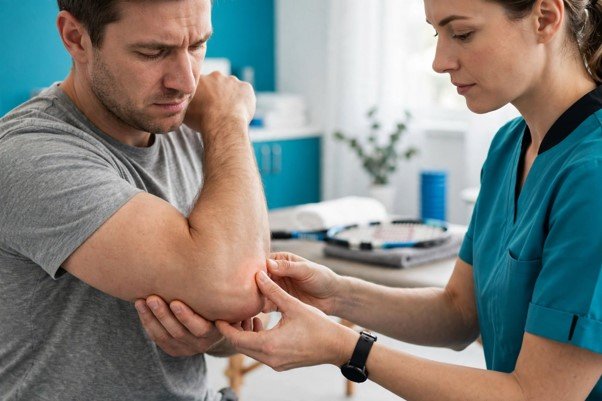
What Is Tennis Elbow?
Tennis elbow, medically known as lateral elbow tendinopathy or lateral epicondylitis, affects the tendons that attach the forearm muscles to the outer part of the elbow.
These muscles help extend the wrist and fingers and are involved in gripping, lifting and twisting movements. Repeated loading can irritate or overload the tendon attachment, leading to pain and reduced function.
Despite its name, tennis elbow does not only affect people who play tennis. It can develop in people who perform repetitive tasks at work, use tools, lift weights, play racket sports or regularly carry out activities involving gripping.
Common symptoms include:
- Pain or tenderness around the outside of the elbow.
- Discomfort when gripping or holding objects.
- Pain when lifting something with the palm facing downwards.
- Weakness when carrying shopping or lifting household items.
- Discomfort when turning a handle, using tools or shaking hands.
- Pain that increases during or after repetitive arm movements.
Symptoms may develop gradually rather than following one specific injury.
Why Does Tennis Elbow Sometimes Persist Despite Rest?
Rest can help reduce irritation, particularly when symptoms have developed after a sudden increase in activity. However, avoiding all movement for an extended period does not necessarily restore the tendon’s ability to tolerate everyday demands.
Tendons respond to appropriate, progressive loading. If the arm is not gradually strengthened, returning to normal activities may reproduce symptoms.
There are several reasons why tennis elbow may continue despite initial treatment.
1. The tendon has not regained its strength
Pain may settle temporarily when activity is reduced, but the tendon and surrounding muscles may still lack the strength and capacity required for normal tasks.
This can lead to recurring discomfort when patients return to work, exercise or household activities.
2. Everyday activities continue to overload the elbow
Some patients cannot completely avoid the movements that aggravate their symptoms.
Repetitive gripping, lifting, keyboard-related tasks, manual work and sports activities may continue to place stress on the affected tendon.
Treatment may need to include practical changes to how these activities are performed.
3. Rehabilitation may need adjusting
Not every exercise programme is suitable for every stage of recovery.
The resistance, frequency and progression of exercises may need to be reviewed according to pain levels, strength and functional ability.
4. The original diagnosis may need reviewing
Pain around the elbow can have several possible causes. Problems involving the neck, nerves, elbow joint or other tendons can sometimes produce similar symptoms.
If the expected improvement has not occurred, a clinician may need to reconsider whether lateral elbow tendinopathy is the correct diagnosis.
What Should Be Reviewed When Tennis Elbow Is Not Improving?
Persistent symptoms are a reason to reassess the condition rather than automatically repeat the same treatment.
A specialist assessment may consider:
- How long symptoms have been present.
- Whether pain is getting better, worsening or remaining unchanged.
- Which movements reproduce the discomfort.
- Whether grip strength has reduced.
- The type of work, sport or daily activity placing stress on the arm.
- What physiotherapy or other treatments have already been tried.
- Whether there are signs of another elbow, nerve or neck condition.
A physical examination can help assess elbow movement, tenderness, grip strength and the function of the surrounding muscles.
Ultrasound or other imaging may be considered when the diagnosis is uncertain, symptoms are unusual or another condition needs to be investigated. Imaging is not automatically necessary for every patient.
What Treatment Options Can Be Considered for Persistent Tennis Elbow?
The most appropriate approach depends on the diagnosis, severity of symptoms, duration of the problem and the effect on everyday activities.
There is no single treatment that works for everyone. Options may include the following.
1. Reviewing and progressing physiotherapy
A structured rehabilitation programme is often an important part of managing persistent tennis elbow.
Treatment may include:
- Progressive wrist extensor strengthening.
- Isometric exercises where appropriate.
- Gradual resistance training.
- Exercises to improve grip strength.
- Movement and activity modification.
- A planned return to work, sport and other demanding activities.
The aim is to improve the tendon and forearm muscles’ ability to tolerate normal loading.
If previous physiotherapy has not helped, it may be useful to review whether the exercises were appropriate, whether progression was gradual and whether the programme addressed the activities that trigger symptoms.
2. Modifying activities that aggravate the elbow
Complete inactivity is not usually a practical long-term solution.
Instead, patients may benefit from temporarily adjusting the movements that place the greatest stress on the elbow.
Depending on the activity, this might involve:
- Reducing repetitive gripping.
- Avoiding sudden increases in lifting or training.
- Using larger-handled tools where practical.
- Taking regular breaks during repetitive tasks.
- Keeping loads closer to the body when lifting.
- Gradually increasing activity as symptoms allow.
These adjustments can help reduce excessive loading while maintaining movement and function.
3. Medication for short-term symptom relief
Some patients may benefit from pain relief or anti-inflammatory medication, depending on their medical history and other medicines.
Topical anti-inflammatory treatments may be considered for local discomfort. Oral anti-inflammatory medication may not be suitable for everyone and can have side effects.
Medication may help manage symptoms, but it does not replace an appropriate rehabilitation programme.
4. Shockwave therapy
Extracorporeal shockwave therapy is a treatment sometimes considered for persistent tendon problems.
It delivers mechanical pressure waves to the affected area. It may be discussed in selected cases, but the evidence for its effectiveness in tennis elbow is not definitive.
A clinician should explain the uncertainty around expected benefits and whether this approach is appropriate for the individual condition.
5. Platelet-Rich Plasma (PRP) injections
Platelet-rich plasma, commonly known as PRP, is prepared using a sample of the patient’s own blood. The blood is processed to produce a platelet-rich preparation, which is then injected into the selected treatment area.
PRP has been investigated as a possible treatment for several tendon conditions, including tennis elbow.
However, it is important to understand that the evidence is mixed. Research has not established that PRP provides a reliable benefit over placebo for lateral elbow tendinopathy. Patients should not assume that it will repair the tendon, eliminate pain or prevent surgery.
Anyone considering this option should receive a balanced explanation of the available evidence, possible risks, costs and alternative treatments.
You can read more about the clinic’s approach to PRP injection treatment for tendinitis and tendon-related conditions.
6. Is surgery necessary?
Most people with tennis elbow do not automatically need surgery.
Surgical treatment may occasionally be discussed when symptoms remain significantly limiting despite an appropriate period of non-surgical management and the diagnosis has been carefully reviewed.
The potential benefits, limitations and recovery requirements should be discussed with an appropriately qualified specialist.
Surgery should not be viewed as the inevitable next step simply because initial physiotherapy has not worked.
Is PRP Suitable for Everyone With Persistent Tennis Elbow?
No. PRP is not suitable or necessary for every patient with elbow pain.
A decision about whether to consider an injection should take account of:
- Whether the diagnosis has been confirmed.
- How long symptoms have persisted.
- The extent of tendon involvement, where relevant.
- Previous rehabilitation and treatment.
- The patient’s general health and medical history.
- The available evidence and its limitations.
- The patient’s expectations and preferences.
The British Elbow and Shoulder Society’s patient care pathway advises that people considering PRP for lateral elbow tendinopathy should be made aware that it may provide no benefit over placebo.
This is important because treatment decisions should be based on realistic expectations rather than promises of guaranteed improvement.
When Should You See a Specialist for Tennis Elbow?
It may be appropriate to seek further assessment if:
- Elbow pain continues despite a reasonable period of self-management.
- Physiotherapy has not produced the expected improvement.
- Pain is interfering with work or everyday activities.
- Grip strength is noticeably reduced.
- Symptoms repeatedly return when normal activity resumes.
- The diagnosis is uncertain.
- You are considering an injection or another specialist treatment.
Seek prompt medical assessment if elbow pain follows a significant injury, there is marked swelling or deformity, the arm becomes difficult to move, or you develop new numbness or significant weakness.
A specialist can help determine whether the problem is persistent tennis elbow or another condition requiring a different treatment approach.
How Can a Sports Injury Specialist Help?
Persistent elbow pain can be frustrating, particularly when it affects work, exercise and ordinary daily tasks.
A sports injury or orthopaedic assessment can help establish the likely cause of symptoms and identify which treatments may be appropriate.
The assessment may involve reviewing previous treatment, examining the elbow and surrounding structures, assessing strength and movement, and deciding whether further investigations are necessary.
Where appropriate, patients can discuss non-surgical treatment options and whether a specialist injection assessment is worth considering.
Ortho Remedy Clinic provides sports injury assessment and treatment in Manchester and sports injury assessment and treatment in Glasgow.
The appropriate treatment depends on the individual diagnosis and clinical assessment. The aim is to help patients understand their options and make an informed decision about the next stage of care.
Frequently Asked Questions About Persistent Tennis Elbow
1. How long does tennis elbow usually take to improve?
Recovery varies between individuals. Many cases improve gradually over several months, although some people experience symptoms for longer. The duration depends on the severity of the problem, activity levels and response to treatment.
2. Why is my tennis elbow not getting better with physiotherapy?
There may be several reasons. The rehabilitation programme may need adjusting, the tendon may still be exposed to excessive loading, or the original diagnosis may need reviewing. A reassessment can help identify what needs to change.
3. Can tennis elbow become a long-term problem?
Yes. Some people experience symptoms for many months, particularly when the affected tendon continues to be overloaded or rehabilitation has not restored its strength and capacity.
4. Should I stop exercising if I have tennis elbow?
Not necessarily. Some activities may need temporary modification, but complete inactivity is not usually required. A suitable exercise programme can help maintain strength and gradually improve the arm’s ability to tolerate activity.
5. Is PRP injection effective for tennis elbow?
PRP has been studied for tennis elbow, but the evidence remains uncertain. The British Elbow and Shoulder Society advises that patients should be told PRP may provide no benefit over placebo. A clinician should discuss the evidence and alternatives before treatment is considered.
6. Is PRP better than a steroid injection for tennis elbow?
The available evidence does not establish one injection as the best option for every patient. Treatment studies have different designs and findings, and comparisons with steroid injections do not necessarily demonstrate that PRP is better than a placebo. The potential benefits and limitations of each approach should be discussed individually.
7. Can tennis elbow heal without an injection?
Yes. Many cases improve without injections or surgery. Activity modification, appropriate strengthening and time are important parts of non-surgical management.
8. Do I need an MRI or ultrasound for tennis elbow?
Not always. The diagnosis is often made through a medical history and physical examination. Imaging may be considered if symptoms are unusual, the diagnosis is uncertain or another problem needs to be investigated.
9. When should I consider seeing an orthopaedic or sports injury specialist?
Consider an assessment if symptoms continue despite appropriate self-management or physiotherapy, interfere with everyday activities, or repeatedly return. A specialist can review the diagnosis and discuss suitable treatment options.
10. Does tennis elbow always require surgery if physiotherapy fails?
No. Surgery is not inevitable. The diagnosis and previous treatment should be reviewed, and other appropriate non-surgical options may be discussed before surgery is considered.
11. Can tennis elbow affect people who do not play tennis?
Yes. It can affect anyone whose work, hobbies or daily activities involve repetitive gripping, lifting or wrist movements. Manual workers, office workers, gym users and people who play other sports can all develop the condition.
12. Can tennis elbow return after treatment?
Symptoms can return, particularly if the arm is exposed to sudden increases in activity before strength and function have recovered. Gradual strengthening and sensible activity progression may help reduce the likelihood of recurrence.
Final Thoughts
Persistent tennis elbow does not necessarily mean that treatment has failed or that surgery is the only remaining option.
When symptoms continue despite rest or physiotherapy, the next step is to review the diagnosis, understand what may be maintaining the pain and consider whether the rehabilitation or treatment plan needs to change.
PRP and other specialist treatments may be discussed in selected cases, but their potential benefits should be considered alongside the limitations of current evidence.
A proper clinical assessment can help patients understand the available options and decide on a sensible way forward.